(Updated November 2026)
Read this passage and note how you feel each time you start a new sentence:
The correctness of Plaintiffs’ contention with regard to their need to allege only that the employer knew that the illegal workers it hired had been “brought into” this country illegally would not render Plaintiffs’ allegations sufficient. Plaintiffs only allege that Mohawk hired, harbored, and encouraged illegal workers. Plaintiffs do not allege that any of these workers were “brought into” the United States illegally. None of the allegations cited by Plaintiffs allege that anyone brought the workers into the country illegally. Plaintiffs’ own erroneous interpretation of § 1324(a)(3) does not allow their allegations to state a claim.
Do you feel as though you’re inside a bumper car?
Now here’s the same passage again, this time with the transitions that Virginia Seitz actually used:
Virginia Seitz, Williams v. Mohawk Industries
Even if Plaintiffs were correct that they need only allege that the employer knew that the illegal workers it hired had been “brought into” this country illegally, Plaintiffs’ allegations are still insufficient. In short, Plaintiffs only allege that Mohawk hired, harbored, and encouraged illegal workers; Plaintiffs do not allege that any of these workers were “brought into” the United States illegally. In fact, none of the allegations cited by Plaintiffs allege that anyone brought the workers into the country illegally. Thus, even under Plaintiffs’ own erroneous interpretation of § 1324(a)(3), their allegations still do not state a claim.
In advocacy writing, sprinkling in such “signpost” words and phrases helps clarify your logic and push your prose ahead. Of course, before you can insert these signposts, you’ll need to figure out how your sentences and thoughts relate to one another. By filling in those missing links, you’ll make your writing flow.
How to Choose Transition Words in Legal Writing
All brief writers use at least some logical connectors. The most popular ones include moreover, additionally, however, furthermore, and nevertheless. Heralded in law school writing classes, these words also pepper the canned “model” memos and briefs in many legal-writing textbooks.
So what’s the problem? First, these words get old fast. You need to have dozens of transition words at your disposal, not just a handful. Second, they’re formulaic and heavy. Third, they’re generic.
When lawyers use moreover, furthermore, or additionally, they usually just want to make a new point, regardless of whether it’s related to the old one: “The statute is on point. Additionally, Petitioner misrepresented what we said at the hearing.” In a similar way, nevertheless and however become catch-alls for all sorts of vague contrasts, counterarguments, and exceptions.
You can still use such transitions to good effect in small doses. But you should also broaden and deepen your repertoire.
In his much-heralded brief for the state of Alaska in Alaska v. EPA, for example, Chief Justice John Roberts used a few moreovers and furthermores. But he also included such varied signals as at bottom, also, under that approach, in short, to this end, because, then, for example, in each case, in any event, of course, instead, to begin with, indeed, and thus.
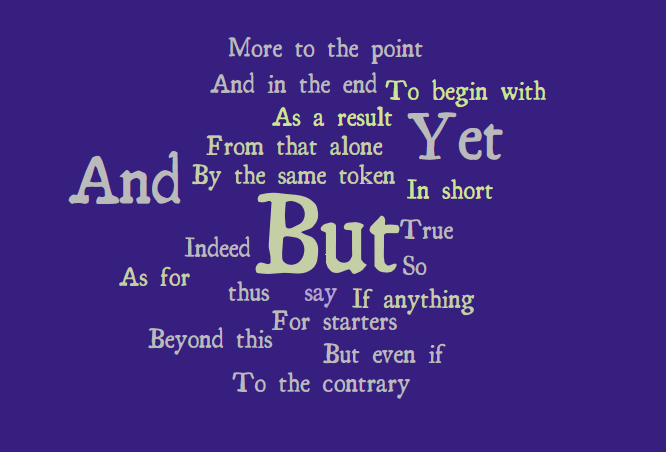
In that spirit, let me share what I believe is the most comprehensive list available of transitions for lawyers and other advocates. I’ve arranged these 135 signposts according to your goal for the sentence. In general, favor the shorter options in each category:
The 135 Transition Words and Phrases, Grouped by Purpose
To provide another point
Additionally · And · Along with · Also · Another reason · As well (as) · Besides · Further · Furthermore · In addition · Moreover · Nor · To X, Y adds Z · What is more
To conclude
Accordingly · All in all · Consequently · Hence · In brief · In conclusion · In short · In sum · In summary · In the end · Then · Therefore · Thus · To summarize
To extract the essence
At bottom · At its core · At its root · In effect · In essence · In the end · The bottom line is that
To show cause and effect
And so · And therefore · And thus · As a result · Because · For · For that reason · In consequence · On that basis · So · That is why · To that end · To this end · With that in mind
To draw an analogy or comparison
As in X, Y · As with X, Y · By analogy · By extension · Here · In each case · In like manner · In the same way · Just as X, so Y · Like X, Y · Likewise · Similarly · So too here · So too with
To draw a contrast
At the same time · But · By contrast · Despite · For all that · Instead · However · In contrast · In the meantime · Nevertheless · Not · Rather · Unlike (in) · Yet
To give an example
As an example · As in · By way of example · First, second, third, etc. · For example · For instance · For one thing · Imagine (as first word of sentence) · Including · In that regard · Like · Say · Such as · Suppose (as first word of sentence) · Take (as first word of sentence) · To illustrate
To concede a point or to preempt a counterargument
All of that may be true, but · All the same · Although · At least · At the same time · Even assuming · Even if · Even so · Even still · Even though · Even under · For all that · Of course · On the other hand · Otherwise · Still · That said · Though some might argue · To be sure · True enough
To redirect
At any rate · (Even) more to the point · In all events · In any event
To emphasize or expand
Above all · All the more because · All the more reason · All the more X because Y · By extension · Especially · Even more (so) · If anything · In effect · In fact · In other words · In particular · Indeed · Not only X, but (also) Y · Particularly · Put another way · Put differently · Simply put
Transition Words in Action: Examples from Top Advocates
Let me share some examples of these transition words in context.
On the trial side, here is Seth Waxman seeking a permanent injunction for MercExchange against eBay:
Seth Waxman, MercExchange v. eBay
Nor is the eBay holding limited to permanent injunctions. The Court’s reasoning applies with even greater force at the preliminary injunction stage, where a plaintiff has at best shown a likelihood of success, not actual success on the merits. Indeed, eBay rested its holding on Amoco Production Co. v. Gambell, which itself involved a preliminary injunction and rejected a presumption of irreparable harm in favor of traditional equitable factors. The Supreme Court’s eBay decision therefore solidified the rule set out in Amoco that presumptions “contrary to traditional equitable principles” are not permissible for any type of injunction.
In great persuasive writing, you will often find several transition words or phrases in a short passage. Consider this example from appellate guru Roy Englert on behalf of Saudi Arabia:
Roy Englert, Federal Insurance Company v. Kingdom of Saudi Arabia
Here, Saudi Arabia is alleged to have provided material support for terrorism, so, as the Second Circuit recognized, the relevant exception is the [Foreign Sovereign Immunities Act’s] terrorism exception. That exception, however, applies only when the U.S. Department of State has designated the defendant state as a state sponsor of terrorism. The State Department has never so designated Saudi Arabia. To the contrary, the State Department has identified Saudi Arabia as a crucial ally, emphasizing that the United States and Saudi Arabia are “united in the war against terror.”
(Note that Englert moves “however” inside the sentence close to the verb rather than sticking it out front.)
Emphasis added in excerpts.